


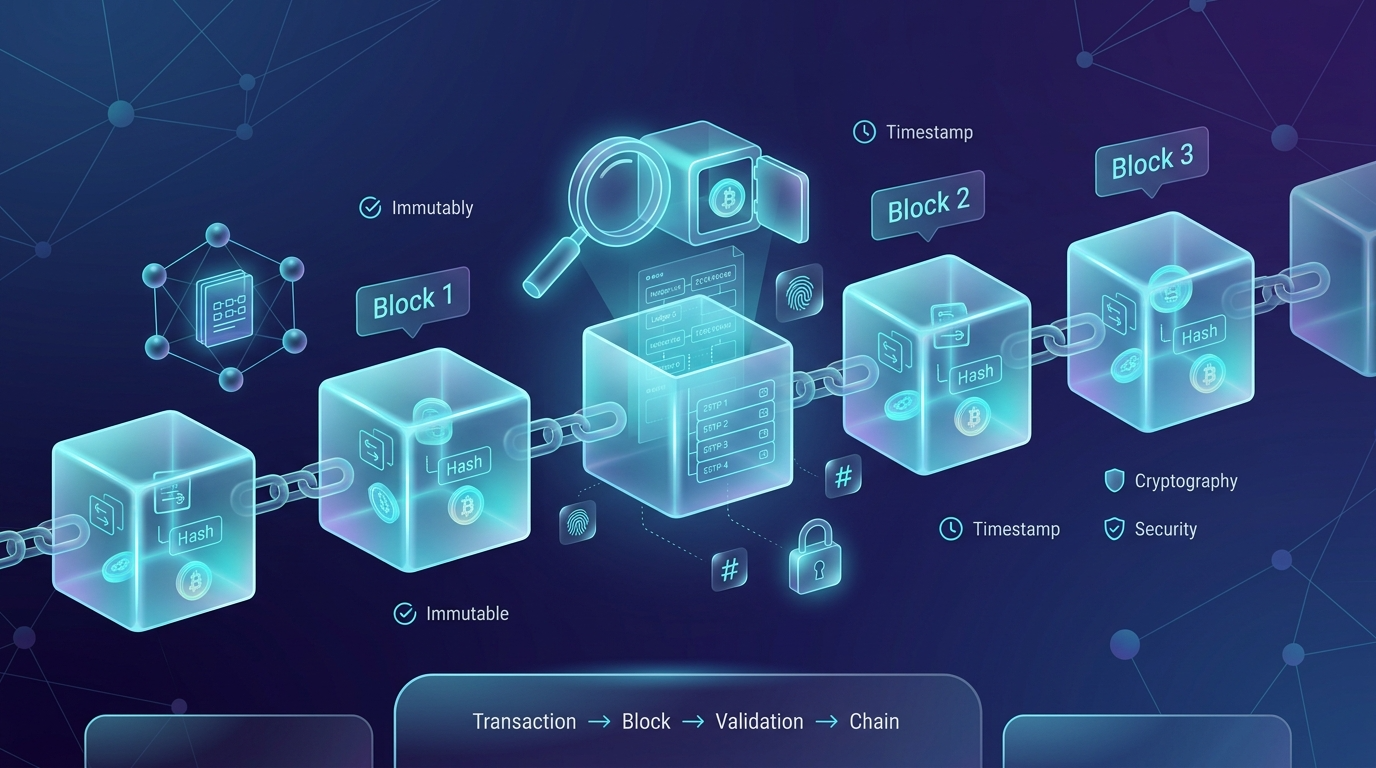
Over the past few years, the term “blockchain” has become an integral part of discussions about cryptocurrencies, digital payments, and modern financial technologies. However, while many people encounter this concept regularly, not everyone fully understands what it actually means. In reality, the basic principle behind blockchain is much easier to grasp than most technical explanations suggest.
Put simply, blockchain is a distributed database where information is stored as a continuous chain of records. These records are simultaneously maintained across a large number of devices connected to the network. Because of this structure, no single party can independently alter transaction history or delete information that has already been verified.
Most cryptocurrencies, including Bitcoin, Ethereum, and many other digital assets, operate on blockchain technology. It enables participants to transfer value directly to one another without relying on banks or other centralized intermediaries.
For more useful insights into cryptocurrencies and digital payments, read the AtlantPay blog. Fast and secure cryptocurrency exchange in Ukraine and the EU. Transparent terms and competitive exchange rates.
What Is a Blockchain Made Of
The term “blockchain” comes from two English words: “block” and “chain.” As the name suggests, it is a sequence of interconnected blocks. Each block contains a specific set of data. In cryptocurrency networks, this data usually consists of transaction records.
Once information has been validated, it is grouped into a block and added to the existing chain. Every new block is linked to the previous one, creating a unified and chronological system of data storage.
Because all blocks are connected, altering a single record without affecting the rest of the chain is extremely difficult. Any unauthorized modification becomes immediately visible to network participants.
Why Blockchain Cannot Be Easily Tampered With
One of the main advantages of blockchain technology is its resistance to data manipulation. After a record has been confirmed, copies of the information are stored on numerous computers around the world.
If someone attempts to modify transaction history on a single device, that altered version will no longer match the copies held by other participants. As a result, the network rejects the unauthorized changes and preserves the original data.
Blockchain also relies on cryptographic mechanisms that connect blocks together and help detect any attempt to interfere with stored information.
These features have made blockchain one of the most secure technologies available for maintaining digital records.
Where Is Blockchain Used
Although blockchain became famous through cryptocurrencies, its applications now extend far beyond digital assets.
Today, blockchain-based solutions are used in a variety of sectors, including:
international money transfers;
electronic document management;
identity verification systems;
logistics and supply chain platforms;
digital agreements and smart contracts;
next-generation financial services;
data storage and record management.
By reducing dependence on intermediaries and increasing transparency, blockchain helps improve efficiency across many industries.
What Benefits Does Blockchain Offer Users
The growing popularity of blockchain is driven not only by its technical capabilities but also by the practical advantages it provides to everyday users.
Some of the most important benefits include:
enhanced data security;
transparent transaction history;
absence of a single controlling authority;
24/7 transaction availability;
resilience against failures of individual network nodes;
fast transfers of digital assets between participants;
reduced reliance on intermediary organizations.
These advantages have made blockchain a key component of the modern digital economy.
Why Cryptocurrencies Rely on Blockchain
Before blockchain technology emerged, electronic transactions depended on centralized institutions responsible for maintaining records and verifying payments. Blockchain introduced a different approach, where trust is established through the network itself rather than through a central authority.
Every transaction is validated by network participants and permanently recorded in a distributed ledger. This allows users to manage and transfer their digital assets without surrendering control to third parties.
For this reason, blockchain became the foundation of the cryptocurrency industry and continues to play a central role in the development of innovative financial products. Understanding how blockchain works helps users navigate the digital asset market more confidently, perform transactions more securely, and take full advantage of modern financial technologies.
 Affiliate rate
 Be the first to receive favorable payment solutions
 Personalized technical support 24/7
 Unique bots to simplify your work
 Partner's personal cabinet
 Flexible customization system for any task






