


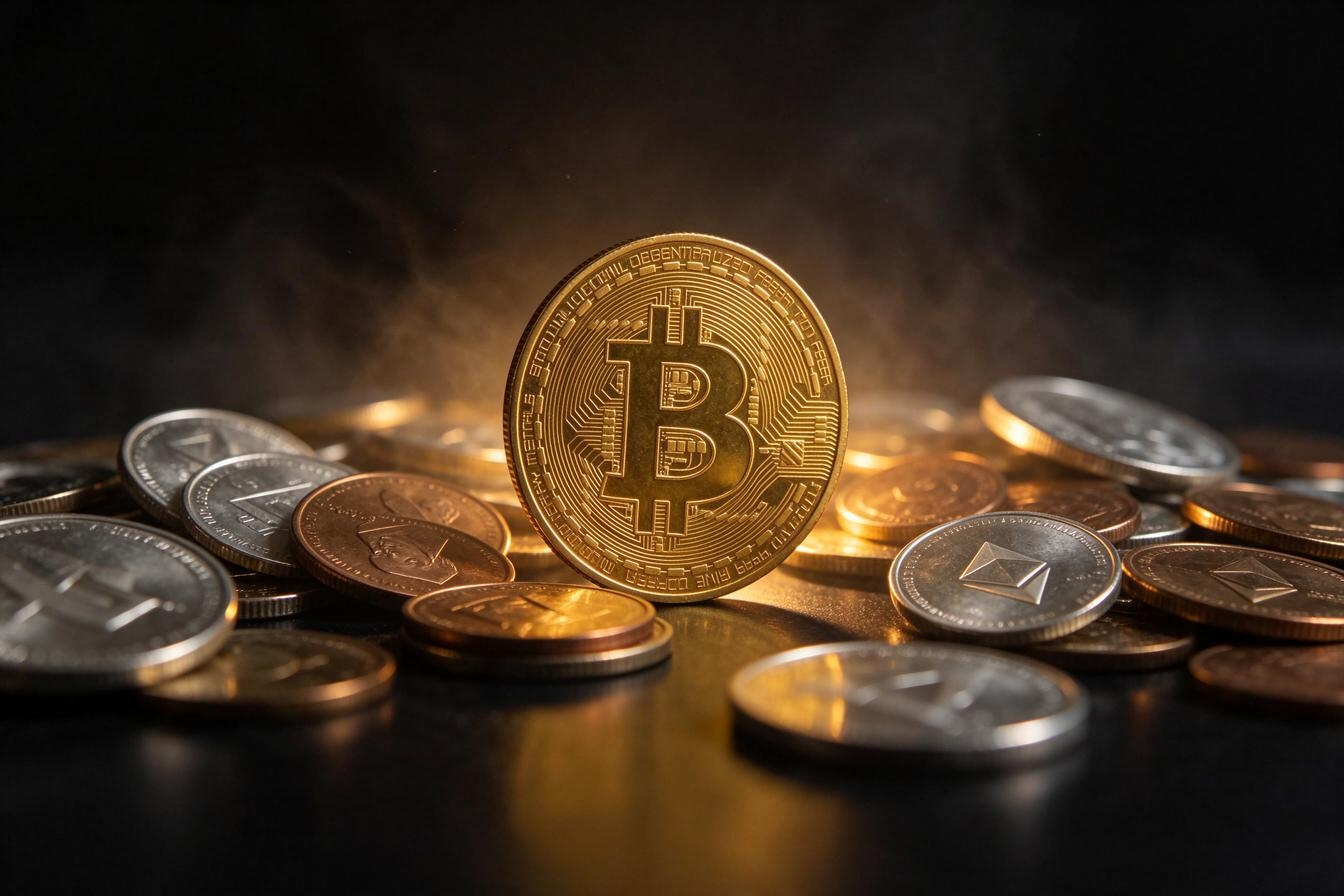
The cryptocurrency market includes thousands of digital assets, but their price movements are often linked to Bitcoin. When the price of BTC changes noticeably, similar dynamics can be seen in Ethereum, Solana, and smaller coins. At the same time, altcoins may react more strongly.
Bitcoin's influence on altcoins can be explained by the position of the first cryptocurrency, capital flows, and the behavior of market participants. It is important to consider both project-specific events and BTC price dynamics.
Why Altcoins Depend on Bitcoin
Bitcoin has a large market capitalization. For many market participants, changes in the value of BTC serve as an indicator of overall market sentiment.
When demand for Bitcoin increases, interest may shift to other coins. During a sharp decline in BTC, market participants often reduce their positions in riskier assets. In such situations, altcoins may lose value faster.
This does not mean that every coin completely follows the Bitcoin chart. Ethereum, Solana, XRP, and other projects have their own technologies and project-specific developments.
What Happens to Altcoins When BTC Rises
When Bitcoin rises quickly and attracts a significant share of capital, altcoins do not always grow at the same time. Some market participants sell other coins to increase their BTC positions. As a result, Bitcoin strengthens, while individual tokens may lose value relative to it.
The situation can change once BTC price movements slow down. When the price remains within a certain range, capital sometimes moves into Ethereum and other assets. Attention gradually shifts toward other coins.
Therefore, Bitcoin and altcoins do not necessarily begin to rise at the same time.
How a Bitcoin Decline Affects Other Coins
A sharp decline in BTC usually puts pressure on a significant part of the market. Altcoins may fall more sharply. One reason is the difference in liquidity.
Coins with smaller market capitalizations are more sensitive to large sell-offs. If holders exit such assets at the same time, demand may not be sufficient to maintain the previous price.
Liquidations in the derivatives market also have an additional impact. A rapid BTC price movement can trigger the automatic closure of leveraged positions. Volatility increases, and price fluctuations spread to other trading pairs.
The Role of Bitcoin Trading Pairs
Many cryptocurrencies are traded not only against stablecoins but also directly against BTC. These pairs show the value of an altcoin in Bitcoin.
A token's price in US dollars may increase along with the broader market, while its value against BTC declines. This means that Bitcoin grew more strongly during the same period.
Therefore, an altcoin-to-USDT chart alone is not enough for a complete assessment. Comparing a coin with BTC helps determine whether it is showing independent price dynamics or simply following the broader market trend.
What Is Bitcoin Dominance
Bitcoin dominance reflects BTC's share of the total cryptocurrency market capitalization.
An increase in this indicator may suggest that capital is becoming more concentrated in Bitcoin. During such periods, altcoins may underperform BTC. A decline in Bitcoin dominance is sometimes accompanied by growing interest in other digital assets.
This indicator should be considered together with the Bitcoin price and the overall state of the market. Bitcoin dominance can change during both cryptocurrency market growth and decline.
Why Altcoins React More Strongly
A smaller project may have significantly lower liquidity than Bitcoin. Less capital is required to move its price. An asset may rise quickly when demand increases and fall sharply when the number of sellers grows.
Token distribution also matters. If a large share of the supply belongs to a limited number of holders, the actions of major holders may noticeably affect market conditions.
For this reason, a BTC movement of several percent can sometimes be accompanied by much stronger fluctuations in individual coins.
Can Altcoins Rise Independently of Bitcoin
An individual cryptocurrency can show its own price dynamics. A technology update, network development, increased user activity, or changes to token mechanics may attract attention to a project.
However, during a sharp Bitcoin decline, positive developments do not always allow an altcoin to maintain its value. When market participants reduce risk exposure, pressure can spread across different categories of digital assets.
How to Consider Bitcoin's Influence on Altcoins
The relationship cannot be reduced to the rule that “Bitcoin rises — all coins rise.” The speed of BTC price movements, capital flows, Bitcoin dominance, and the liquidity of individual assets all matter.
Bitcoin may be the first to react to changing interest in the cryptocurrency market. The movement can then spread to major altcoins and other market segments. During a decline, this process often develops faster as participants reduce positions in highly volatile assets.
Read more on the AtlantPay blog. Fast and secure cryptocurrency exchange in Ukraine and the EU. Transparent terms and competitive exchange rates. Understanding how Bitcoin affects altcoins helps assess digital assets and avoid viewing an individual coin separately from the broader cryptocurrency market.
 Affiliate rate
 Be the first to receive favorable payment solutions
 Personalized technical support 24/7
 Unique bots to simplify your work
 Partner's personal cabinet
 Flexible customization system for any task





