


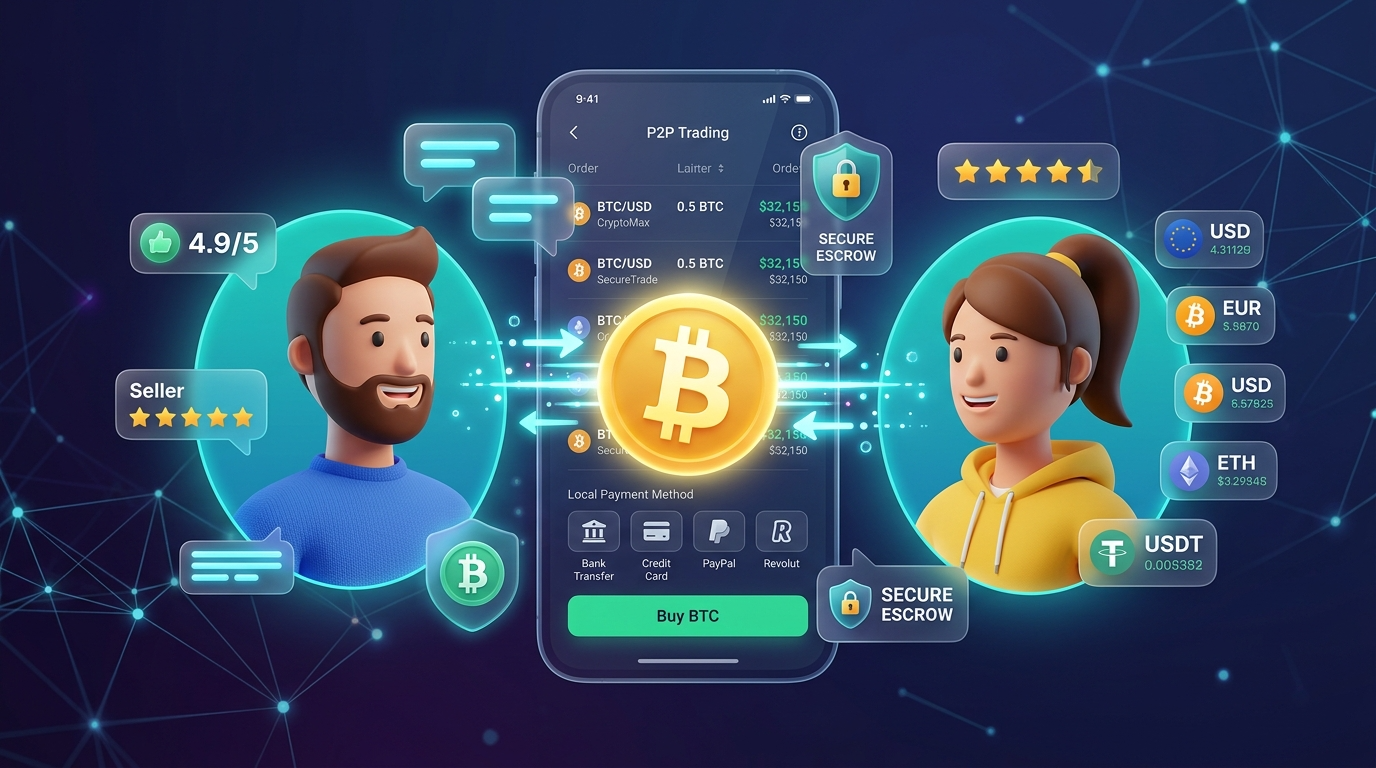
The digital asset market has changed significantly in recent years. Users are relying less on traditional exchanges and standard online exchangers. Instead, many are moving toward P2P trading — a format where participants conduct transactions directly with each other without the direct involvement of a financial intermediary.
The essence of the P2P model lies in direct interaction between two users. One participant publishes an offer to sell cryptocurrency, specifies the price, minimum transaction amount, and available payment methods. The second user selects a suitable offer and confirms the transaction. Once the payment is completed, the digital asset is automatically transferred to the buyer.
Unlike the traditional exchange model, P2P trading is not tied to a single fixed rate. The asset price is determined by the platform participants themselves. Because of this, users can often find more выгодные предложения for buying Bitcoin, Ethereum, or USDT.
Why the P2P Format Has Become Popular
Interest in direct transactions has grown due to the flexibility of the conditions. Users independently decide whom to trade with, which payment system to use, and at what rate to purchase the asset. For many people, this approach is more convenient than using centralized exchange services.
Transaction speed also plays an important role. When instant bank transfers are used, a deal can be completed within minutes. Stablecoins are especially popular in P2P trading because they are convenient for international transfers and storing funds.
Another reason for the growing popularity is the wide range of payment options. Modern P2P platforms support bank cards, electronic payment services, and SEPA transfers. Users from different countries can choose the most convenient payment method without strict limitations.
How a P2P Transaction Works
The process differs from a standard online exchanger. After an offer is published, the cryptocurrency is temporarily reserved within the platform. While the seller is waiting for payment, the asset remains locked. As soon as the transfer is confirmed, the system automatically completes the transaction.
An escrow mechanism is used to protect participants. The platform holds the cryptocurrency until the deal is finalized, which reduces the risk of fraud. This approach gives buyers additional assurance that the seller will not cancel the transfer after receiving the payment.
When selecting a counterparty, users usually pay attention to the account rating, the number of completed transactions, and the activity history. These factors help evaluate the reliability of the other side of the deal.
Advantages of P2P Cryptocurrency Trading
The popularity of this format is driven by several key advantages:
freedom to choose exchange conditions;
the ability to compare rates from different sellers;
fast transactions between users;
support for multiple payment methods;
access to buying USDT, Bitcoin, and Ethereum;
a transparent transaction process;
the ability to independently choose a counterparty.
At the same time, security largely depends on the user’s attentiveness. It is not recommended to transfer funds outside the platform or agree to conduct deals through third-party messengers. Reliable services record every stage of the transaction within the system, helping users avoid disputes and fraudulent activity.
Today, P2P trading is gradually becoming a separate segment of the cryptocurrency market. Users value this format for its flexibility, fast transaction processing, and the ability to independently manage exchange conditions without relying on traditional banking mechanisms.
 Affiliate rate
 Be the first to receive favorable payment solutions
 Personalized technical support 24/7
 Unique bots to simplify your work
 Partner's personal cabinet
 Flexible customization system for any task






